
By Panoramic Capital Partners
A manufacturing business owner sat across from me, exhausted. He’d spent the past year working with a consultant, developed a beautiful strategic plan, held quarterly offsites, and his leadership team could recite their “strategic priorities” from memory.
His business value? Unchanged. Revenue flat. EBITDA margins actually declined.
I asked to see his strategic plan. It was impressive – professionally designed, color-coded priorities, vision statements, even a mission and values refresh.
“Show me who owns what,” I said.
Silence.
They had identified “Increase recurring revenue” as a top priority. Great. But no one owned “Launch annual maintenance program by Q2.” No one was accountable for “Converting top 20 customers to retainers by Q3.” No one had “Develop recurring service tier pricing by Q1” on their actual to-do list.
They had a strategy. What they didn’t have was execution.
This is the gap that kills most strategic planning efforts – the space between “what we want to accomplish” and “who’s doing what by when.” Value Drivers tell you where to focus. Strategic Initiatives are the specific, measurable actions that actually get you there.
Where We Are in the NorthStar System
Let’s recap where we are in the NorthStar Value Creation System:
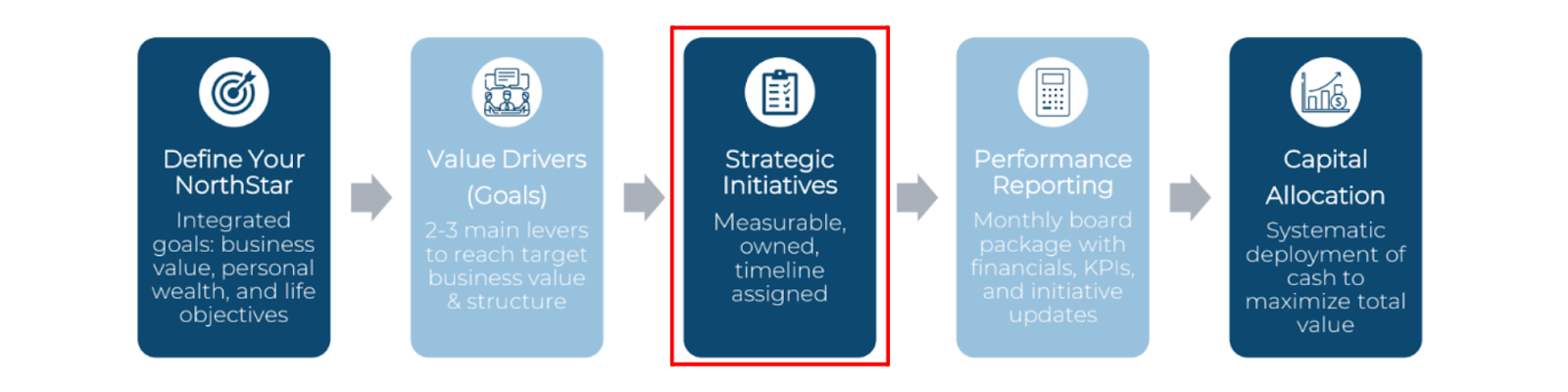
- Component 1 (covered 10/28/25): Define Your NorthStar – your integrated business value, personal financial, and life goals
- Component 2 (covered 12/9/25): Identify Your 2-4 Value Drivers – the fundamental levers that will increase your enterprise value over the next 12-24 months
- Component 3 (today): Strategic Initiatives – the specific, measurable projects that pull those levers
- Coming next: Performance Reporting & KPIs – the dashboard that tells you if your initiatives are translating into actual business results, plus Capital Allocation – where everything comes together
Strategic Initiatives are where the rubber meets the road. This is where you transform “we need to diversify our customer base” into “Sarah will launch an outbound campaign targeting 50 prospects in the healthcare vertical by Q3.”
What Are Strategic Initiatives?
Strategic initiatives are the specific, measurable projects that, when executed over the next 3-6 months, will achieve your value drivers.
They have four non-negotiable characteristics:
- Measurable Outcome
Not “improve sales process” but “Implement CRM tracking 100% of leads with automated follow-up by March 31.”
Not “strengthen the management team” but “Hire COO and transfer daily operations responsibilities by Q2.”
The outcome must be binary or quantifiable – you either did it or you didn’t, or you can measure progress (40% complete, 75% complete, etc.).
- Single Owner
One name. Full accountability. Not “sales team” or “operations department” or “TBD.”
If you can’t write down a single person’s name who will wake up thinking about this initiative and lose sleep if it’s behind schedule, you will fail.
- Clear Timeline
Specific deadline. Not “ongoing” or “Q2-ish” or “when we have time.”
“Complete by March 15” or “Launch by end of Q2” or “Hire by August 1.”
- Directly Tied to Value Driver
Every initiative must clearly advance one of your 2-4 value drivers. If you can’t draw a straight line from the initiative to a value driver, it’s either not strategic or you’re missing a value driver.
If you want a template that forces accountability on each of these 4 tests when creating your strategic initiatives, reach out and we’ll send it over.
The Critical Distinction: Inputs vs. Outputs
Value Drivers are outputs – the outcomes you want to achieve. Strategic Initiatives are inputs – the work that gets you there.
Example:
Value Driver (Output): Diversify customer base to no customer >15% of revenue
Strategic Initiatives (Inputs):
- Hire business development manager by Q2 (Owner: CEO)
- Launch outbound campaign targeting 50 prospects in new vertical by Q3 (Owner: Business Development Manager)
- Develop case studies and sales materials for new vertical by Q1 (Owner: Marketing Director)
- Implement CRM to track all prospects and automate follow-up by Q2 (Owner: COO)
- Attend 3 industry conferences in target vertical by year-end (Owner: Business Development Manager)
See the difference? The value driver is what you’re trying to accomplish. The initiatives are the specific work that will make it happen.
The Volume Question: How Many Is Too Many?
When we walk clients through this process, we can see the panic set in as we start multiplying out the initiatives.
“Wait – if I have 3 Value Drivers and each one has 5 initiatives, that’s 15 things we need to execute on?”
Yes. And that’s actually realistic.
Here’s the math:
3 Value Drivers × 3-7 initiatives each = 9-21 total initiatives
- These are distributed across your team
- One person can (and should) own multiple initiatives
- The initiatives vary significantly in size and complexity
Capacity Reality Check:
The number of executable initiatives depends entirely on the size of your organization:
- 10-person company: Maybe 8-12 executable initiatives at once
- 50-person company: 15-20 is realistic
- 200-person+ company: Could be 25-30 or more
The key is that your senior leadership team should each own 2-5 initiatives. Depending on size and scale, they have teams below them to execute the actual work.
Think about a value driver like “Grow revenue 30% in next 12 months.” The initiatives under that might include sales initiatives (hire 2 reps, implement new CRM, launch outbound program) and marketing initiatives (rebuild website, launch ad campaign, develop new messaging, engage graphic designer for brand refresh).
That’s 7 initiatives right there under one value driver. But they’re owned by different people – your head of sales owns 3, your head of marketing owns 4. They each have teams below them doing the actual execution.
Where Most Business Owners Fail
Let us save you some pain by highlighting the most common failure patterns we see:
Failure Pattern #1: Never Getting This Granular
Business owners stay at the 30,000-foot level. They have value drivers but no tactical breakdown of how to achieve them.
“Increase recurring revenue” sits on their strategic plan for 18 months. They talk about it in leadership meetings. Everyone nods. Nothing happens.
Why? Because no one owns “Build annual maintenance program pricing model by Q1” or “Convert top 30 customers to retainers by Q3” or “Launch recurring service tier by Q2.”
Without this level of granularity, strategy remains theoretical.
Failure Pattern #2: Not Linking Initiatives to Value Drivers
These business owners have lists. Lots of lists. Projects that need to get done. Good ideas. Urgent priorities.
But when you ask “How does upgrading your office space increase your enterprise value?” or “Which value driver does implementing a new time-tracking system support?” – silence.
If you can’t draw a straight line from an initiative to a value driver (and from that value driver to either EBITDA growth or multiple expansion), it’s not a strategic initiative. It might be important operational work, but it’s not strategic.
Failure Pattern #3: The Owner Owns Everything
We review a client’s strategic initiatives list and see the CEO’s name on 12 of the 15 initiatives.
That’s not a strategic plan – that’s a bottleneck diagram.
If the CEO’s name is on 80% of initiatives, you’ve identified exactly why the business isn’t scaling. The owner is the constraint.
The Owner’s Actual Role
This deserves its own section because it’s counterintuitive for most entrepreneurs.
As CEO, your name should be on very few – ideally zero – initiatives.
“But wait,” you’re thinking, “I’m the most capable person in my organization. I execute faster than anyone. Of course I should own the critical initiatives.”
That’s precisely the thinking that caps your business value.
What the Owner SHOULD Be Doing:
- Holding the team accountable in weekly meetings
- Removing roadblocks when initiatives go yellow or red
- Making strategic decisions when direction needs to change
- Ensuring resources are allocated properly
- Thinking about the business, not working in the business
The Scaling Reality:
If you’re a 10-person company, yes – the owner will have their name on several initiatives. That’s reality. You don’t have enough people to distribute the work.
But if you’re 50+ people and the owner still has 8 initiatives? You have a delegation problem that’s directly constraining your enterprise value.
Buyers discount heavily for owner dependency. If you can’t delegate strategic initiatives, you can’t sell your business at its full market value.
The Exception:
The one scenario where the owner should own initiatives is if they’ve carved out a specific domain expertise role – typically product development or innovation.
If you’re the visionary product person and that’s your defined role (not CEO/operator), then yes, own the product development initiatives. But hire someone else to be CEO and run the rest of the business.
Building Your Strategic Initiatives: The Process
Let’s get practical. Here’s how to actually build your initiatives:
Step 1: Start With Your Value Drivers
Take each of your 2-4 value drivers and ask: “What specific actions, if completed in the next 3-6 months, would move the needle on this?”
Not “what could we do” but “what specific work, with measurable outcomes and clear owners, would advance this value driver?”
Step 2: Brainstorm Exhaustively, Then Cut Ruthlessly
For each value driver, generate 10-15 potential initiatives. Get everything on the table.
Then narrow to the 3-7 that are:
- Highest impact (moves the value driver most)
- Actually executable with current resources
- Not dependent on 10 other things happening first
This is hard. You’ll have more good ideas than capacity to execute. That’s the point – focus requires saying no.
Step 3: Apply The Four Tests
For each potential initiative, run it through these tests:
The Measurement Test:
- Bad: “Improve customer service”
- Good: “Reduce average response time to under 4 hours by Q3”
- Bad: “Build strategic partnerships”
- Good: “Execute signed partnership agreements with 3 industry leaders by Q4”
- Bad: “Enhance our technology stack”
- Good: “Implement new ERP system with all historical data migrated by June 30”
If you can’t measure it, you can’t manage it. And if you can’t manage it, it’s not an initiative – it’s a hope.
The Ownership Test:
- Bad: “Sales team” or “Operations department” or “TBD”
- Good: “Sarah Johnson (Sales Director)” or “Mike Chen (COO)”
If you can’t name a specific person who will own this initiative, you’re not ready to execute. Either you don’t have the right people in place, or you haven’t clarified roles and responsibilities enough.
The Timeline Test:
- Bad: “Ongoing” or “2025” or “When we get to it”
- Good: “Complete by March 15” or “Launch by end of Q2” or “Hire by August 1”
Initiatives without deadlines drift. Human nature requires forcing functions.
The Value Driver Test:
Can you draw a straight line from this initiative to one of your 2-4 value drivers?
If not, you have two possibilities:
- It’s not actually strategic work (might be important operations, but not strategic)
- You’ve identified a missing value driver
Example: You have an initiative to “Implement new cybersecurity protocols by Q3” but none of your value drivers relate to risk management or operational excellence. Either this initiative doesn’t belong on your strategic list, or you’re missing “Reduce operational risk to command premium multiple” as a value driver. It also may be too small to deserve a spot in your Value Drivers worksheet. If you have an IT lead that is not consumed, this item can be added to their plate but is not a strategic initiative.
Step 4: Acknowledge Dependencies, But Don’t Get Paralyzed
Yes, “Launch marketing campaign” logically depends on “Finalize brand messaging.” We get it.
Name the dependency. Put both initiatives on the list. Assign owners. Let them figure out the sequencing.
Don’t use dependencies as an excuse for inaction. In weekly meetings, the team will naturally coordinate and adjust timing. But if you try to perfectly sequence everything upfront, you’ll spend 3 months planning and never start executing.
Strategic Initiatives vs. Business As Usual
Before we keep going, we need to make a critical distinction that trips people up constantly – the distinction between working on your initiatives that move the business forward and executing in your core business. Here’s how to tell the difference:
NOT Strategic Initiatives:
- Delivering client work (that’s operations – the core of your business)
- Accounts payable and receivable (that’s finance operations)
- Responding to customer support tickets (that’s customer service operations)
- Replacing someone who quit (that’s maintaining current capacity)
- Any client-specific deliverable (that’s fulfillment)
- Regular reporting, meetings, or administrative work
ARE Strategic Initiatives:
- Hiring 2 NEW sales reps to expand beyond current capacity
- Implementing a new CRM system that changes how you manage customer relationships
- Launching a new service line that doesn’t exist today
- Building a strategic partnership that opens new distribution channels
- Documenting and systematizing processes that currently live in people’s heads
- Developing new product offerings
The Test: Is this forward-looking work that will change the business, or is it maintenance and operations?
Another way to think about it: If you stopped doing this initiative, would your business continue operating normally in the short term? If yes, it’s strategic (you’re building future capacity/capability). If no (the business would break), it’s operations.
Special Case: Hiring
- Hiring to replace someone who quit = operations (maintaining current capacity)
- Hiring to expand team and add new capability = strategic initiative
- Hiring the first person in a new role (your first marketing person, your first ops manager) = definitely a strategic initiative
Making It Real: The Weekly Execution Cadence
Here’s the minimum viable version of this entire system: Establish a weekly (or bi-weekly) meeting cadence where you review strategic initiative progress.
No fancy software required. No complex dashboards. Just disciplined execution and accountability.
Meeting Format (Modified from EOS L10 structure):
- Duration: 60-90 minutes
- Attendees: Leadership team – specifically, the people who own strategic initiatives
- The Critical Focus: Yellow and red items. Initiatives that are behind schedule or blocked.
Do not spend meeting time on initiatives that are green and progressing. Acknowledge them in 30 seconds and move on. This meeting is about unblocking and accelerating, not reporting for reporting’s sake.
Simple Agenda:
- Quick Wins (5 minutes)
What got accomplished this week? Celebrate momentum. Move on.
- Initiative Updates (30-40 minutes)
Focus exclusively on yellow and red items:
- What’s the blocker?
- What specific help do you need?
- What resources are missing?
- What decision needs to be made?
- What’s your commitment for next week to get this back on track?
Owner commits to specific next actions. Not “I’ll work on it” but “I will complete X by Tuesday.”
- Cascading Communication (5 minutes)
What from this meeting needs to be communicated to the broader team? Who owns that communication?
What This Meeting Is NOT:
- A reporting session where everyone reads status updates (send those in advance)
- A place to discuss day-to-day operations or client issues
- A problem-solving session for tactical delivery challenges
- An opportunity to dump everything on the CEO
What This Meeting IS:
- Focused accountability on strategic work that builds enterprise value
- Rapid identification and removal of roadblocks
- Course correction when initiatives fall behind
- The forcing function that ensures initiatives don’t die quietly
The CEO’s Role in This Meeting:
This is where the CEO earns their keep. You’re not executing initiatives – you’re removing obstacles, making decisions, and holding people accountable.
If someone says “I’m blocked on X,” your job is to unblock them or help them find the path forward. If someone consistently comes to meetings unprepared or with excuses, your job is to have a direct conversation about accountability.
Managing the Lifecycle of Initiatives
When an Initiative Is Completed:
Mark it 100% complete. Celebrate the win (seriously – acknowledge accomplishments). Move focus and resources to remaining initiatives.
Don’t feel pressure to immediately add a new initiative to replace it. Completing initiatives gives you more capacity to accelerate the remaining work.
If you finish 3 of your 15 initiatives in the first two months, great – now you have more focus and resources for the remaining 12.
When an Initiative Is Consistently Stuck:
Address it directly in the weekly meeting:
- Is this actually the right initiative?
- Do we need different resources or a different owner?
- Is the timeline unrealistic?
- Has the business context changed in a way that makes this less important?
- Should we replace it with something else?
Don’t let stuck initiatives linger for months out of stubbornness. If something isn’t working, acknowledge it and adjust.
Mid-Cycle Adjustments:
Changing initiatives mid-cycle should require formal review and agreement among the senior team. Don’t change them every week (that undermines accountability), but don’t be dogmatic if circumstances dramatically change.
If you lose a major customer and your “expand into new vertical” initiative suddenly becomes much more urgent while your “launch new product line” initiative becomes less critical – adjust. But do it deliberately, not reactively.
Refresh Cadence:
How often should you completely reset your strategic initiatives?
- Smaller businesses (<25 people): Every 6 months. Why? Your top priority is likely growing revenue, and that won’t fundamentally change every quarter. You need time for initiatives to play out before judging success.
- Mid-size businesses (25-100 people): Every 6 months or Quarterly. Why? You have more moving parts and faster evolution. Quarterly gives you enough time to execute while staying responsive.
- Larger businesses (100+ people): Quarterly. Why? More resources allow faster execution, and larger businesses often have more market dynamics requiring quick adjustment.
Common Mistakes Beyond The Big Three
Mistake #4: Treating All Initiatives as Equal Priority
Not all initiatives are created equal. Some will move the needle significantly more than others.
Focus your weekly meetings on:
- The initiatives with highest conviction for business impact
- The initiatives that are currently behind schedule
Don’t give equal airtime to the easy initiative that’s humming along and the critical initiative that’s stuck.
Mistake #5: Using Dependencies as an Excuse
“We can’t start initiative B until initiative A is complete.”
Maybe. But probably not entirely true. There’s usually some version of parallel work that can happen.
Name the dependency. Put both on the list. Let the owners coordinate. You’ll be surprised how often “dependencies” are really just convenient excuses to delay difficult work.
Mistake #6: No One Actually Owns Accountability
If the CEO doesn’t run the weekly meeting with real teeth – if people show up unprepared, if yellow items stay yellow for weeks with no consequences, if missed deadlines get shrugged off – initiatives die quietly.
Accountability must live somewhere. Usually with the CEO. If you’re not willing to hold people’s feet to the fire, don’t be surprised when strategic initiatives become suggestions.
Mistake #7: Making Them Too Small
“Return 3 customer phone calls” is not a strategic initiative. That’s a task.
Strategic initiatives should represent meaningful work that takes weeks or months and materially advances your value drivers.
If you can knock it out in an afternoon, it’s a task, not an initiative.
Mistake #8: Confusing Activity With Progress
“Had 5 meetings about the new CRM” is activity.
“CRM selected, contract signed, implementation partner engaged, data migration plan completed” is progress.
Measure outcomes, not effort. No one cares how hard you worked if nothing changed.
Mistake #9: Building Initiatives Around What’s Easy
The initiatives that will actually move your value drivers are often uncomfortable. They require new skills, new hires, difficult conversations, or changing how you’ve always done things.
If all your initiatives feel comfortable and easy, you’re probably not being strategic enough. Real value creation requires getting outside your comfort zone.
Integration With Existing Systems
Many business owners reading this are already running EOS (Rocks), or have some quarterly planning process in place.
This system isn’t meant to duplicate what you’re doing. Ask yourself these questions:
- Are your current quarterly priorities (Rocks, OKRs, whatever you call them) actually tied to quantifiable value drivers?
- Can you explain exactly how achieving your current priorities will increase your enterprise value?
- Does every priority have a single owner and specific deadline? Or do you have “department goals” owned by “the team” with vague timelines?
- Are you tracking these weekly with real accountability? Or do they get reviewed once a quarter when it’s too late to course-correct?
This NorthStar system either:
- Replaces your current planning process if it’s generic, unfocused, or not tied to business value creation
- Enhances your current system by adding the explicit linkage to value drivers and enterprise value
Don’t run two parallel systems. Look at what you have through this lens and determine if you’re already functionally doing this, or if you need to adopt this framework.
If you’re running EOS well and your Rocks clearly tie to business value drivers, you’re probably already doing most of this. The NorthStar system just makes the connection to enterprise value explicit and systematic.
The Bridge to Performance Reporting
You now have the core execution engine of the NorthStar system in place:
✓ Your NorthStar – where you’re headed (business, financial, life goals)
✓ Your Value Drivers – the 2-4 levers to get there
✓ Your Strategic Initiatives – the specific work to pull those levers
But how do you know if it’s actually working?
That’s where Performance Reporting and KPIs come in – our next article in this series.
Here’s the critical distinction:
- Strategic Initiatives are forward-looking. They tell you what work you’re doing.
- KPIs tell you whether that work is translating into actual business results.
A preview of what’s coming:
Financial reporting tells you what already happened. Your P&L for October tells you how October went. Useful, but it’s rearview mirror information.
KPIs tell you what’s happening right now and what’s likely to happen next. If your sales pipeline is shrinking, you’ll know about it before it hits your P&L. If customer retention is slipping, your KPIs will show it before it shows up in revenue.
Together, financial reporting and KPIs form your monthly board reporting package – the dashboard that keeps your entire system pointed at your NorthStar.
Quick Summary:
Imagine this scenario: All your sales initiatives are “on track.” Your sales manager reports green status on hiring new reps, implementing the CRM, and launching the outbound program.
But your sales pipeline KPI shows pipeline shrinking by 30% over the past two months.
You have a problem. And you caught it early because you’re measuring the right things.
That’s the power of Performance Reporting – the topic of our next article.
Your Action Steps
This Week:
- Pull out your 2-4 Value Drivers (from our previous article)
- For each Value Driver, brainstorm 5-10 potential initiatives
- Reality check: Which could actually get done in the next 3-6 months with your current team?
This Month:
- Narrow to your final list (probably 9-15 total initiatives across all value drivers)
- Assign a single owner to each initiative
- Set specific deadlines (not “in Q3” but “by September 15”)
- Test each one: Is it measurable? Is it tied to a value driver? Is it actually executable?
Next Quarter:
- Establish your weekly meeting cadence (60-90 minutes, focus on yellow/red items)
- Hold the first meeting – expect it to be rough. That’s normal.
- By week 3-4, you should find a rhythm
- Watch your value drivers actually start moving
The Bottom Line
Strategic planning without execution is just expensive fiction. Value Drivers without Strategic Initiatives are aspirations, not reality.
The businesses that actually increase their enterprise value are the ones that translate strategy into specific, measurable, owned initiatives – and then relentlessly execute with weekly accountability.
This isn’t sexy. It’s not a silver bullet. It’s systematic, disciplined execution of the fundamentals.
After 2 months, it probably gets repetitive and boring – that’s what running a business effectively is – relentless execution.
But it’s the difference between talking about building value and actually building it.
To learn more about how Panoramic Capital Partners can help you implement the NorthStar Value Creation System in your business, visit us at panoramiccp.com or reach out to our team directly.
If you haven’t yet assessed your business’s readiness for value creation and transition, take our free COMPASS Score assessment at https://panoramiccp.com/compass-score/.
Panoramic Capital Partners (“Panoramic”) is a registered investment advisor.
The information provided is for educational, informational, and illustrative purposes only and does not constitute investment advice and it should not be relied on as such. It should not be considered a solicitation to buy or an offer to sell a security. It does not take into account any investor’s particular investment objectives, strategies, tax status or investment horizon. Panoramic Capital Partners and its advisors do not provide legal, accounting, or tax advice. You should consult your attorney or tax advisor.
The views expressed in this commentary are subject to change based on market and other conditions. This article may contain certain statements that may be deemed forward looking statements. Please note that any such statements are not guarantees of any future performance and actual results or developments may differ materially from those projected. Any projections, market outlooks, or estimates are based upon certain assumptions and should not be construed as indicative of actual events that will occur.
All information has been obtained from sources believed to be reliable, but its accuracy is not guaranteed. There is no representation or warranty as to the current accuracy, reliability, or completeness of, nor liability for, decisions based on such information and it should not be relied on as such.
Advisory services are only offered to clients or prospective clients where Panoramic and its representatives are properly licensed or exempt from licensure.