
The $10 Million Mistake Hidden in Your Strategic Plan
A business owner sat across from us, frustrated. She’d spent a year working with an implementer, developed 10 quarterly priorities (“Rocks” in EOS terminology), and her team had been executing diligently.
The result? The business flatlined. Profitability goals missed. Enterprise value unchanged.
I asked to see her 10 priorities. Nine focused on culture and people initiatives. One on business development.
“These are all good ideas,” I said. “But which ones actually increase what a buyer would pay for your business?”
Silence.
This is the difference between business activities and value drivers. One keeps the lights on. The other builds wealth.
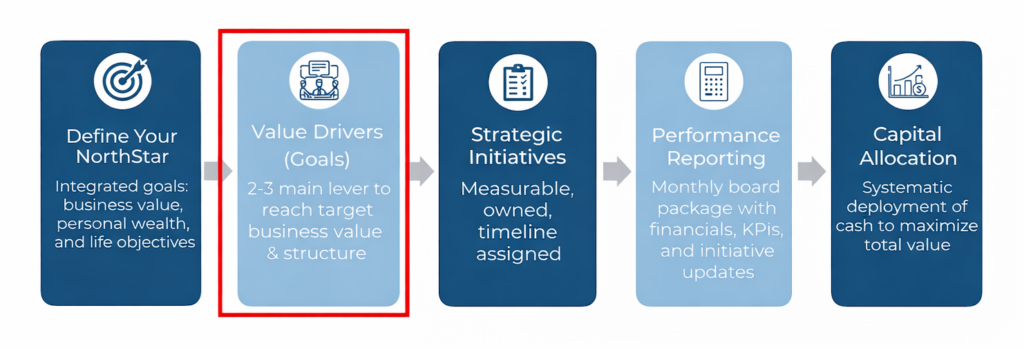
Where We Are in the NorthStar System
In our previous article, we covered how to define your integrated NorthStar – your combined business value, personal financial, and life goals.
What Are Value Drivers?
Value drivers are the 2-4 changes in your business that, when executed over the next 12-24 months, will measurably increase your enterprise value.
They are:
- Specific to your business situation
- Measurable
- Connected to what buyers pay for
- Within your control to execute
They are NOT:
- Day-to-day operations (delivering your product/service is table stakes)
- Every good idea you have
- Generic goals like “increase revenue”
- Tactical tasks (those become Strategic Initiatives in the next step)
Critical distinction: Value drivers focus on building enterprise value, not running your business. Running your business well is required to stay alive. Value drivers make your business worth more when you eventually sell, transition, or pass it on.
Why Only 2-4?
Three reasons this constraint is intentional:
1. Resource Allocation Reality
Your business has finite attention, capital, and execution capacity.
The math is brutal:
- 15 priorities with equal resources = 6.7% focus per priority = incremental progress
- 3 priorities with focused resources = 33% focus per priority = transformational change
A business that’s excellent at 3 things commands premium multiples. A business that’s mediocre at 15 things does not.
2. The Identification Problem
If you have 15 “value drivers,” you haven’t actually identified what drives value – you’ve listed things that influence it.
Everything influences your business value: your website, your HR policies, your office layout, your customer service scripts. But only 2-4 things will fundamentally change your valuation multiple in the next 12-24 months.
The discipline of narrowing to 2-4 forces you to answer: “What actually matters most right now?”
3. The Execution Reality
Back to our opening story. That business owner with 10 priorities didn’t fail from lack of effort. She failed because meaningful progress on 10 fronts simultaneously is impossible.
The outcome: lots of activity, minimal value creation. The business flatlined, and she had to reset.
Had she focused on 2-3 value drivers that directly addressed enterprise value, the story would be different.
The Two Lenses: Quantitative and Qualitative
Effective value drivers work through two complementary lenses:
Lens 1: The Quantitative (Financial) Perspective
Enterprise Value = EBITDA × Multiple
Your value drivers must either:
- Increase EBITDA (revenue growth or margin expansion)
- Increase the multiple (improve business quality/reduce risk)
- Ideally both
Work backward from your NorthStar:
- Personal financial goals → Required wealth outside business (informs business North Star)
- Business value goals → Required enterprise value (or sustainable cash generation to achieve personal)
- Value drivers → How you’ll achieve that enterprise value
Example:
- Personal Goal: minimum $25M liquid wealth outside the business
- Business Goal: Exit at $40M in 5 years
- Current State: $15M valuation (7.5x on $2M EBITDA)
- Gap: $25M value increase needed
- Implication: Must roughly double EBITDA AND expand multiple from 7.5x to ~10x
Your value drivers must address both sides of this equation.
Lens 2: The Qualitative (Multiple) Perspective
Buyers pay premium multiples for specific characteristics:
- Predictable, recurring revenue
- Diversified customer base (no customer >10-15%)
- Strong gross margins (demonstrating pricing power)
- Professional management team (operates without owner)
- Scalable systems and processes
- Growth in expanding markets
- Defensible competitive position
Your value drivers should directly address weaknesses in these areas or strengthen existing advantages.
How to Identify YOUR 2-4 Value Drivers
Step 1: Conduct an Honest Assessment
On Predictability & Risk:
- How predictable are my cash flows? Project-based or recurring?
- Customer concentration? Would losing my top 3 customers devastate me?
- How dependent is the business on me personally?
- How volatile are my margins year-over-year?
On Growth & Market Position:
- What’s my realistic growth trajectory?
- Am I in a growing or declining market?
- What’s my competitive moat?
- Can I scale without proportional overhead increases?
On Operations & Team:
- Could my business operate for 2 weeks if I disappeared?
- Do I have a complete management team?
- Are processes documented and repeatable?
- Do we have professional-grade financial reporting?
Step 2: Identify Your Biggest Gaps AND Opportunities
The best value drivers sit at the intersection of:
- Your biggest risk/weakness (threats to valuation)
- Your biggest leverage (opportunities to create value)
Common patterns by stage:
Early-Stage ($1-3M EBITDA):
- Typical gaps: Owner-dependent, project revenue, informal processes
- Common value drivers: Build recurring revenue streams, hire and empower first management layer, document core operating systems
Growth-Stage ($3-10M EBITDA):
- Typical gaps: Customer concentration, capacity constraints, margin pressure
- Common value drivers: Diversify beyond top 3-5 customers, expand into adjacent markets/service lines, improve gross margins through efficiency or pricing power
Scale-Stage ($10M+ EBITDA):
- Typical gaps: Growth slowing, market position vulnerable, succession unclear
- Common value drivers: Execute strategic acquisitions, develop next generation leadership, expand into new geographies/verticals
Step 3: The Filtering Questions
For each potential value driver, ask:
- Impact Test: If we execute brilliantly, does it materially change our enterprise value?
- Buyer Test: Would a sophisticated buyer pay a premium multiple because of this?
- Execution Test: Can we move the needle in 12-24 months with focused effort?
- Measurement Test: Will we definitively know if we’re succeeding?
If any answer is “no,” it’s not a true value driver.
Real-World Examples
Example 1: The Professional Services Firm
Background:
- $4M EBITDA professional services firm
- Working with EOS implementer, developed 10 quarterly “Rocks”
- 9 focused on culture/people, 1 on business development
The Problem: All 10 were good ideas. But 9 had minimal direct impact on enterprise value. After one year: business flatlined, profitability goals missed, owner exhausted.
The Reset—3 Value Drivers:
1. Diversify Revenue Beyond Top 3 Clients
- Current: Top 3 = 40% of revenue
- Target: No client >15% of revenue within 18 months
- Why: Massive risk reduction = multiple expansion from 5x to 7-8x
2. Convert Project Revenue to Recurring Retainers
- Current: 90% project-based
- Target: 40% of total revenue becomes recurring within 18 months
- Why: Predictable cash flows command premium multiples
3. Hire and Empower COO to Run Daily Operations
- Current: Owner runs everything
- Target: Owner out of day-to-day within 12 months
- Why: Removes key person risk, makes business saleable
The Impact:
- Projected valuation: $4M EBITDA × 5x = $20M → $4M EBITDA × 7.5x = $30M
- $10M of value creation through focused execution
Culture initiatives didn’t disappear—they got folded into the COO development process where they belonged.
Example 2: The Manufacturing Business
Background:
- $8M EBITDA manufacturer
- Good growth and margins, but 6x multiple (industry range 6-10x)
- Goal: Exit at top of range within 3 years
The Analysis: What’s preventing premium multiple?
- Top customer = 35% of revenue
- Operational bottlenecks limiting growth
- 80% revenue from one product category
The 3 Value Drivers:
1. Expand Product Portfolio Into Adjacent Categories
- Target: New product lines generating $2M of EBITDA (20% of $10M total after growth) within 24 months
- Why: Reduces concentration + demonstrates growth capability
- Impact: Growth trajectory + diversification = 1-2x multiple expansion
2. Diversify Customer Base to No Single Customer >15%
- Target: Win 8-10 new customers to reduce customer concentration
- Why: Massive risk reduction Impact: 1-2x multiple expansion
3. Eliminate Production Bottlenecks for 40% Capacity Increase
- Target: Increase capacity from $70M to $100M with existing facilities (capacity, not actual revenue: capacity needs to stay ahead of revenue to facilitate growth)
- Why: Proves scalability + positions for growth
- Impact: Scalability proof = 1x multiple expansion
The Math:
- Current: $8M EBITDA × 6x = $48M
- Projected: $10M EBITDA × 9x = $90M (within 3 years)
- Value created: $42M
Example 3: The Service Business with Margin Pressure
Background:
- $3M EBITDA service business
- Decent revenue growth but margins declining from 25% to 18% over 3 years
- Owner concerned about sustainability
The 2 Core Value Drivers:
1. Restore and Stabilize Gross Margins to 28%+
- Target: Systematic pricing + service mix optimization within 12 months
- Why: Margin profile demonstrates pricing power and quality
- How: Eliminate bottom 20% unprofitable customers, value-based pricing for new clients, develop premium tier
2. Build Repeatable Sales System Independent of Owner
- Target: Owner stops being primary salesperson within 12 months
- Why: Removes dependency + proves revenue is repeatable
- How: Hire sales leader, implement CRM, document sales playbook
Why Only 2? These addressed the biggest valuation concerns: margin sustainability and owner dependency. Everything else was secondary. Trying to fix 6 things simultaneously had created the margin decline in the first place.
Common Mistakes
Mistake #1: Too Many
- Having 8-10 “value drivers” means you haven’t made hard choices.
- Result: progress on nothing.
Mistake #2: Too Vague
- Bad: “Improve operations”
- Good: “Eliminate production bottlenecks to increase capacity 40%”
Mistake #3: Confusing Operations with Value Creation
- Bad: “Deliver excellent customer service”
- Good: “Convert 50% of customers to annual contracts” (recurring revenue)
Delivering your product/service well is table stakes. Value drivers build enterprise value beyond operational excellence.
Mistake #4: Inputs Instead of Outputs
- Bad: “Implement new CRM system”
- Good: “Build repeatable sales process independent of owner measured by owner not involved in new client wins”
The CRM is an input – it becomes a Strategic Initiative (next article). The value driver is the outcome: repeatable, scalable sales.
Mistake #5: Disconnected from Valuation
Value drivers must connect to EBITDA growth OR multiple expansion. If they don’t, they’re not value drivers – they’re nice-to-haves.
Mistake #6: Ignoring Execution Capacity
Picking value drivers that require capabilities you don’t have or would each demand 100% organizational focus. Be realistic about 12-24 month achievability.
From Value Drivers to Strategic Initiatives
You now have your 2-4 value drivers—the levers that will move enterprise value. But they don’t execute themselves.
The Cascade:
- Value Drivers = The 2-4 big levers (what you just defined)
- Strategic Initiatives = The 10-20 specific projects that pull those levers (these are the inputs to be unpacked in our next article)
- Performance Reporting = The financial & KPI reporting that tell you if it’s working (future article)
- Capital Allocation = Where you deploy cash to support it all (future article)
Preview:
Each value driver cascades into 3-7 strategic initiatives.
Example:
- Value Driver: Diversify customer base to no customer >15% of revenue
Strategic Initiatives:
- Hire business development manager by Q2
- Launch outbound campaign targeting 50 prospects in new vertical by Q3
- Develop case studies and sales materials by Q1
- Attend 3 industry conferences by year end
- Implement CRM to track prospects by Q2
Each initiative is measurable, assigned to an owner, and has a deadline. That’s what we’ll build in our next article.
Your Action Steps
This Week:
- Review your current strategic plan/goals/priorities
- Count them. If it’s more than 4, you’re diluting focus
This Month:
- Use the assessment questions to identify your biggest gaps and opportunities
- Draft 3-7 potential value drivers
- Run them through the four filtering tests
- Narrow to your final 2-4
Remember: These aren’t forever—they’re for the next 12-24 months. As you achieve them, you’ll identify new value drivers. The discipline is in saying “not yet” to everything else.
In our next article, we’ll break down how to transform your value drivers into actionable Strategic Initiatives with owners, timelines, and accountability. This is where the NorthStar system becomes operational.
Panoramic Capital Partners (“Panoramic”) is a registered investment advisor.
The information provided is for educational, informational, and illustrative purposes only and does not constitute investment advice and it should not be relied on as such. It should not be considered a solicitation to buy or an offer to sell a security. It does not take into account any investor’s particular investment objectives, strategies, tax status or investment horizon. Panoramic Capital Partners and its advisors do not provide legal, accounting, or tax advice. You should consult your attorney or tax advisor.
The views expressed in this commentary are subject to change based on market and other conditions. This article may contain certain statements that may be deemed forward looking statements. Please note that any such statements are not guarantees of any future performance and actual results or developments may differ materially from those projected. Any projections, market outlooks, or estimates are based upon certain assumptions and should not be construed as indicative of actual events that will occur.
The above targets are estimates based on certain assumptions and analysis made by the advisor. There is no guarantee that the estimates will be achieved.
All information has been obtained from sources believed to be reliable, but its accuracy is not guaranteed. There is no representation or warranty as to the current accuracy, reliability, or completeness of, nor liability for, decisions based on such information and it should not be relied on as such.
Advisory services are only offered to clients or prospective clients where Panoramic and its representatives are properly licensed or exempt from licensure.