
The Problem
“I have an attorney, CPA, financial advisor, and M&A advisor, but I still feel alone.”
This sentiment, shared by a successful manufacturing business owner during a recent conversation, captures a fundamental problem facing entrepreneurs today. Despite having a full roster of professional advisors, many business owners feel like they’re navigating critical decisions in isolation.
The reason? Traditional advisory relationships operate in silos – and worse, they often venture outside their expertise without proper context. Your CPA focuses on last year’s taxes but offers opinions on deal structures. Your attorney handles legal documents but weighs in on business valuations. Your financial advisor tries to opine on how to run your business without ever having run an operating company (or equally likely, you hold back information on your business from them because they haven’t added value for you in this area and just encourage you to park more money with them so they can get paid more). Your investment banker works the transaction but weighs in on investment decisions or doesn’t consider the life implications of the deal they’re pushing you towards.
Each expert delivers valuable services within their specialty, but when they venture beyond their core competency, they’re operating without the full context of your integrated business and personal goals. Meanwhile, no one is actually connecting the dots between your business strategy, personal wealth creation, and life goals.
This fragmented approach creates inefficiencies throughout your business journey, but the costs compound significantly as your company matures and you begin thinking about your eventual transition. During growth phases, missed integration opportunities mean suboptimal capital allocation and slower wealth building. But as you approach transition decisions, the lack of coordination becomes truly costly – both financially and personally.
The Hidden Cost of Fragmented Planning
Consider the story of two business owners, both running $5 million EBITDA companies:
- Owner A follows the traditional advisory model. His CPA handles taxes reactively each April. His financial advisor manages a diversified portfolio of stocks and bonds. His attorney updates his will every few years. When he eventually sells his business for $40 million, he’s surprised by the tax implications, realizes his personal wealth outside the business is minimal, and discovers he has no clear vision for what comes next.
- Owner B uses an integrated approach. Every business decision is evaluated through the lens of both operational impact and personal wealth creation. Excess business cash flows are systematically allocated between growth investments and personal diversification. Tax strategies are planned years in advance. By the time she sells her business, also for $40 million, she’s already built substantial wealth outside the business, minimized tax impacts, and has a clear vision for her next chapter.
Both owners received competent professional advice. The difference? Owner B had a system that integrated all aspects of her planning, while Owner A had a collection of isolated advisory relationships.
Why Traditional Planning Falls Short for Business Owners
The fundamental challenge is that business owners don’t fit the traditional wealth management model. Here’s why:
- Your Business Isn’t Just an Asset – It’s a Blend of Your Life, Your Wealth, and Your Mission When 70-90% of your net worth is tied to your business, traditional portfolio theory doesn’t apply. You can’t simply “diversify” by selling half your business and buying index funds. Your business generates your income, creates your wealth, and will likely fund your retirement. It requires a fundamentally different planning approach.
- Every Business Decision Is a Personal Financial Decision Should you reinvest profits in new equipment or take distributions to build personal wealth? Should you acquire a competitor or pay down debt? These aren’t just business decisions – they’re wealth planning decisions that traditional advisors aren’t equipped to help you navigate. And at each turn, there is an opportunity to further drive value in your business.
- Exit Planning Isn’t Just Transaction Planning Most “exit planning” focuses on the mechanics of selling your business. But real exit planning integrates business value creation, personal financial planning, tax optimization, and life transition planning into a cohesive strategy that begins years before any potential sale.
- You Need Coordination, Not Just Expertise Having the best individual advisors doesn’t help if they’re not working together toward integrated goals. Worse yet, when advisors offer opinions outside their core expertise — without understanding your complete picture — they can actually create conflicting advice that works against your overall objectives. You need someone orchestrating the entire symphony, not just excellent individual musicians playing different songs.
Introducing the NorthStar Value Creation System
At Panoramic Capital Partners, we’ve developed the NorthStar Value Creation System to address these exact challenges. Rather than adding another advisor to your team, we serve as the integrator who coordinates all aspects of your business and personal planning around a unified set of goals.
The system recognizes that for business owners, everything is connected:
- Your business strategy affects your personal wealth
- Your personal financial goals influence business decisions
- Your life vision shapes both business and wealth strategies
- Your eventual transition plans should inform current operations
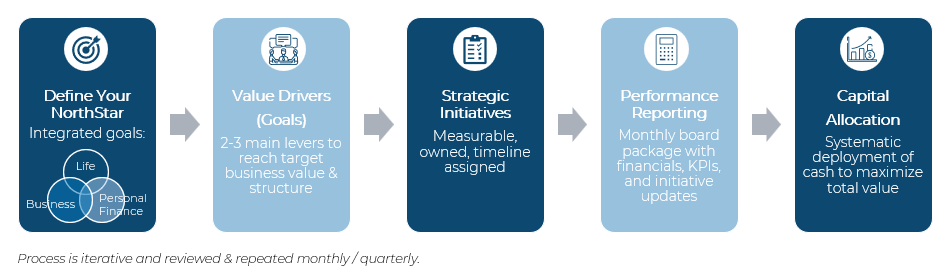
The Five Components of the NorthStar System
1. Defining Your NorthStar
This is where most planning efforts fail – they skip the crucial step of defining what you’re actually trying to achieve. Your NorthStar isn’t just a business valuation target or a retirement savings number. It’s an integrated set of goals that encompasses:
- Business Value Goals: What do you want your business to be worth, and when?
- Personal Wealth Goals: What level of financial security do you need outside of your business?
- Life Goals: How do you want to spend your time, what impact do you want to make, and what legacy do you want to leave?
Without this integrated foundation, you’re optimizing individual components without understanding how they fit together. Furthermore, as an entrepreneur, you’re constantly getting pulled in different directions. This step is all about maintaining focus and bringing you back to the why behind everything you’re doing.
2. Business Value Drivers
Once your NorthStar is defined, we identify the 2-3 main levers that will drive you toward your target business value. These aren’t generic growth strategies – they’re the specific, high-impact initiatives that will create the most value for your unique business.
For a manufacturing company, this might be geographic expansion and operational efficiency. For a service business, it could be recurring revenue development and management team strengthening. The key is focusing on what matters most for your specific situation.
3. Strategic Initiatives
This is where strategy becomes execution. We break down your value drivers into specific, measurable initiatives with clear ownership and deadlines. Each initiative should be:
- Measurable with clear success metrics
- Assigned to a single owner who’s accountable for results
- Time-bound with specific deadlines
- Forward-looking and proactive rather than reactive
These initiatives create accountability and transparency while ensuring progress toward your larger goals.
4. Performance Reporting
This incorporates financial reporting and Key Performance Indicators (KPIs). Traditional financial statements tell you what already happened. KPIs tell you what’s happening now and what’s likely to happen next. We help you develop both backward-looking financial reporting and forward-looking KPIs that track progress on your strategic initiatives.
This creates a monthly board reporting package that keeps everyone focused on what matters most: making progress toward your NorthStar.
5. Capital Allocation
Capital allocation is where everything comes together. When businesses generate cash, how you deploy that cash is one of your most important wealth-creation decisions. Yet most business owners make these decisions reactively, without a clear framework.
Understanding your options is the first step. Every business owner has five fundamental ways to deploy excess cash:
- Reinvest in internal growth – Fund new equipment, expand facilities, hire additional staff, invest in new product development, etc.
- Acquire another company – Pursue strategic acquisitions to accelerate growth, gain market share, or add capabilities
- Pay down debt – Reduce financial leverage to improve cash flow and reduce risk
- Repurchase shares – Buy out co-owners or partners to consolidate ownership
- Distribute cash to owners – Take dividends or distributions to build personal wealth outside of the business
Most business owners intuitively understand these options, but they lack a systematic approach for choosing between them based on their integrated business and personal goals.
We help you create a framework that systematically determines the optimal allocation between these five deployment options, then organizes your cash flows into specific buckets with clear purposes:
- Bucket 1: Maintain operating reserves
- Bucket 2: Fund strategic growth initiatives
- Bucket 3: Build personal wealth outside the business
More buckets can be added for each capital allocation element that fits your situation. This systematic approach ensures that cash flow is tied to specific goals and that your business decisions support both operational success and personal wealth creation. We work with you to establish the right cash allocation strategy, then systematically fill each bucket according to your priorities and goals.
Before going any further, we have to acknowledge that you’re likely already doing one or a few of these components. If you run on EOS or any of the other popular business operating systems, then big rocks, initiatives, and KPI’s will be familiar to you. The goal with this system isn’t to promise some sort of silver bullet that risks being just one more thing on your already full plate. Instead, it’s to take much of what you’re already doing and what’s in your head, and get it organized into a system that stays focused and drives value. It won’t replace something like EOS or E-myth, but it will tie them into your life and personal financial goals. It will also create accountability to ensure that your business is doing more than just operating well and actually creating an asset that’s intrinsically valuable and extends beyond your involvement. That said, we believe each component of the system is foundational to a healthy and valuable business, so you may need to add or upgrade part of your operating system. Bottom line, this system has been designed in the trenches with entrepreneurs based on the gaps that we’ve seen and experienced, and it’s about progress through focus as opposed to progress through chasing perfection.
The Integration Advantage
The magic of the NorthStar system isn’t in any individual component – it’s in how they work together to create compound value creation. Consider how this plays out in practice:
Scenario: Should you acquire a competitor?
Traditional approach: Your banker evaluates the financing. Your attorney structures the deal. Your CPA considers tax implications. Each advisor gives advice within their specialty, but no one helps you see the complete picture.
NorthStar approach: We evaluate the acquisition through your integrated framework:
- How does it advance your Value Drivers?
- What’s the impact on your timeline to reach target business value?
- How does the capital allocation align with your personal wealth goals?
- How much risk are you taking on for your existing business?
- How does it position your business for your eventual exit strategy?
This integrated analysis often reveals opportunities or risks that siloed advice misses.
Beyond the Business: Personal Wealth Integration
One of the most powerful aspects of the NorthStar system is how it connects business decisions to personal wealth creation. Too many business owners reach their exit point only to discover they have minimal wealth outside their business, creating unnecessary reliance on the outcome of the exit and limiting their options.
The capital allocation component specifically addresses this challenge by systematically pushing excess cash to your personal balance sheet once business needs are met. This approach:
- Diversifies your risk by reducing dependence on business value for financial security
- Creates optionality by giving you choices about timing and terms of any eventual exit
- Provides clarity about whether you’re building wealth or just building a larger business
Your Path Forward
If you’re feeling the tension between growing your business and building personal wealth, or if you have great individual advisors but feel like something’s missing in the coordination, the NorthStar system might be exactly what you need.
The system isn’t about replacing your existing advisors – it’s about orchestrating them around a unified vision of what you’re trying to achieve. It’s about ensuring that every business decision supports your personal goals and every personal financial decision strengthens your business strategy.
Most importantly, it’s about never feeling alone in these critical decisions again.
At Panoramic Capital Partners, we’ve built our entire practice around serving as your integrated partner through the complete journey of building, growing, and transitioning your business while creating lasting personal wealth. If you’d like to learn more about how the NorthStar system could work for your specific situation, reach out to our team or visit our website to explore our comprehensive approach.
Panoramic Capital Partners (“Panoramic”) is a registered investment advisor.
The information provided is for educational, informational, and illustrative purposes only and does not constitute investment advice and it should not be relied on as such. It should not be considered a solicitation to buy or an offer to sell a security. It does not take into account any investor’s particular investment objectives, strategies, tax status or investment horizon. Panoramic Capital Partners and its advisors do not provide legal, accounting, or tax advice. You should consult your attorney or tax advisor.
The views expressed in this commentary are subject to change based on market and other conditions. This article may contain certain statements that may be deemed forward looking statements. Please note that any such statements are not guarantees of any future performance and actual results or developments may differ materially from those projected. Any projections, market outlooks, or estimates are based upon certain assumptions and should not be construed as indicative of actual events that will occur.
The above targets are estimates based on certain assumptions and analysis made by the advisor. There is no guarantee that the estimates will be achieved.
All information has been obtained from sources believed to be reliable, but its accuracy is not guaranteed. There is no representation or warranty as to the current accuracy, reliability, or completeness of, nor liability for, decisions based on such information and it should not be relied on as such.
Advisory services are only offered to clients or prospective clients where Panoramic and its representatives are properly licensed or exempt from licensure.