
The Five Decisions Every Dollar Forces You to Make
The Capital Allocation Dilemma
Two business owners, both successful by any measure, both stuck on the same question from completely different angles.
Owner #1 sat in our office staring at $3M sitting in his business checking account. His company was profitable, growing steadily, generating consistent cash flow. But he was paralyzed.
Should he reinvest in new equipment? Hire that sales team he’d been thinking about? Pay down the remaining $2M in debt? Take distributions to finally build some personal wealth outside the business?
He’d been sitting on this cash for eight months, unable to decide. Meanwhile, inflation was eroding its value and his business was missing growth opportunities.
Owner #2 had the opposite problem. She’d built her company to $50M revenue, $5M EBITDA. Beautiful business. She’d reinvested every dollar back into growth for 15 years – new locations, new equipment, new hires.
When she came to us, she had less than $500K in investments outside her business. Her entire net worth – roughly $40M – was locked in one illiquid asset.
She was one bad year, one key customer loss, one market disruption away from disaster. And she didn’t even realize it until we built her complete balance sheet.
Both owners suffered from the same root problem: They had no systematic framework for capital allocation.
This is where most business owners struggle. You know how to run your business. You understand your industry. But when it comes to the question “what do I do with this dollar of cash flow?” – reinvest it, distribute it, use it to pay down debt – you’re making it up as you go.
This is the final piece of the NorthStar Value Creation System, and it’s where business strategy and personal wealth creation finally integrate into one cohesive framework.
Where We Are in the NorthStar System
Over this series, we’ve built:
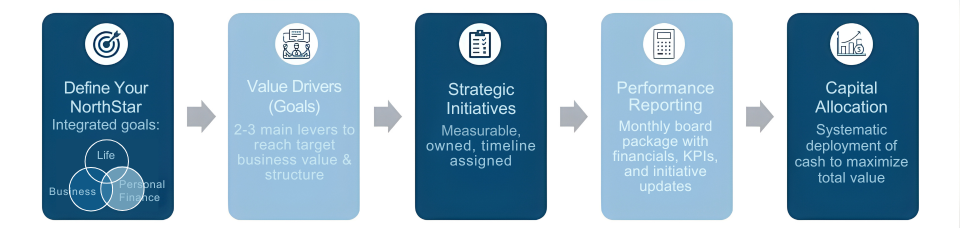
Your NorthStar – your integrated business value, personal financial, and life goals
- Your Value Drivers – the 2-4 specific, measurable levers that increase enterprise value
- Your Strategic Initiatives – the specific work to pull those levers with clear owners and timelines
- Your Performance Reporting – the dashboard showing whether initiatives are translating to results
- Now: Capital Allocation – where you systematically decide how to deploy every dollar of cash flow your business generates.
This is where the entire system comes together. Because here’s the reality that most advisors miss: For business owners, your business cash flow and personal wealth aren’t separate things. They’re one integrated system that needs to be managed holistically.
The Five Deployment Options
Every dollar of free cash flow your business generates can be deployed in exactly five ways:
- Reinvest in the Business – Growth initiatives, personnel, systems, equipment that drive your Strategic Initiatives forward
- Acquire Companies – Add-on acquisitions, roll-ups, strategic tuck-ins
- Pay Down Debt – Reduce financial risk, improve your balance sheet
- Retire Shareholders – Buy back stock, buy out co-owners
- Build Personal Wealth – Distribute cash flow to diversify risk and fund your life
That’s it. Five options. Every dollar goes to one of these five places.
The problem? Most business owners make these decisions reactively – responding to immediate needs or year-end tax planning rather than executing a systematic strategy tied to their long-term goals.
The “Jobs to Cash” Framework
Capital allocation means assigning specific “jobs” to your cash. Once you understand what each dollar’s job is, the decision becomes clear.
Job 1: Establish Your Operating Reserve
How much cash does your business need as a baseline to handle normal fluctuations in working capital, payroll timing, and unexpected expenses?
Rule of thumb starting point:
- Service businesses: 1-2 months of operating expenses
- Product businesses: 2-3 months of operating expenses
- Seasonal businesses: Enough to cover the trough period
Define the number. “We need $500K in operating cash” is very different from “we should probably keep some cash around.”
Job 2: Fund Maintenance Capital
What’s the baseline capital the business needs just to maintain current operations? Equipment replacement, facility maintenance, technology refreshes. This isn’t growth capital – this is what you need to spend just to stay where you are.
Job 3: Meet Capital Structure Obligations
Your debt service requirements and any committed buyout payments. These aren’t optional – they’re contractual obligations that must be funded first.
Job 4: Fund Strategic Growth Initiatives
What cash do your Strategic Initiatives require to hit your Value Driver targets? Your Performance Reporting tells you which initiatives are working and moving your Value Drivers forward. Your capital allocation must fund them.
Job 5: Build Personal Wealth
Here’s the critical insight that most business owners miss: Once Jobs 1-4 are fully funded, excess cash should systematically flow to your personal balance sheet.
Not “someday when the business is worth more.” Now. Systematically. Every quarter.
Why? Because building wealth outside your business:
- Diversifies your risk (reduces concentration in one illiquid asset)
- Creates optionality (you can walk away from bad deals)
- Funds your life goals while you’re building the business
- Positions you to negotiate from strength when you eventually exit
The business owners who get to an exit and realize they have minimal wealth outside their company? They failed at Job 5.
The Integration with Your NorthStar
Capital allocation only makes sense when it’s tied to your complete NorthStar – your three-part integrated goals.
- Business Goals: Fund the Strategic Initiatives that drive your Value Drivers
- Personal Financial Goals: Systematically build wealth outside business to hit your targets
- Life Goals: Create the optionality to live how you want
Example:
Your NorthStar:
- Business: Grow to $20M exit value in 5 years
- Personal Financial: Build $5M in investments outside business in same period
- Life: Work 40 hours/week, take 4 weeks vacation annually
Your capital allocation must fund BOTH the business growth (Job 4) AND the personal wealth building (Job 5). If you only fund Job 4, you’ll build business value but remain dangerously concentrated. If you only fund Job 5, you’ll starve the business and never reach the exit value target.
The integrated approach funds both systematically.
The Two Biggest Mistakes
Mistake #1: Reinvesting Everything Forever
This is Owner #2 from our opening – 15 years of 100% reinvestment, $50M revenue business, $500K outside the business.
The thinking: “My business is my best investment. Why would I take money out?”
The reality: You’re building massive concentration risk. When you finally go to exit, you’re desperate – you NEED the money because you have nothing else. You have no negotiating leverage.
The owners who negotiate the best exits? They’ve built wealth outside the business. They can walk away. They’re negotiating from strength, not need.
Mistake #2: Taking Too Much Out Too Early
Starving the business of capital it needs to grow. If you’re distributing most of your cash flow while Strategic Initiatives are underfunded and Value Drivers aren’t progressing, you’re killing your own business value.
The answer: A systematic approach tied to your specific NorthStar.
Real-World Example: The Compounding Effect
Let’s walk through a specific business to show how this works:
Starting Position:
- $8M revenue, $2M EBITDA
- Generating $1.5M free cash flow annually after debt service
- Current business value: $10M (5x multiple on $2M EBITDA)
- Owner has $500K in investments outside business
NorthStar:
- Business: Build to $20M exit value in 5 years (requires EBITDA growth to ~$3M and multiple expansion to 6.5x-7x)
- Personal Financial: Build $3M in investments outside business over same 5 years
- Life: Owner working 40 hours/week with capable management team in place
Capital Allocation Framework:
- Job 1 – Operating Reserve: $400K target (currently at $350K, need to build $50K in year 1)
- Job 2 – Maintenance Capital: $150K annually
- Job 3 – Debt Service: $500K annually (already covered in the free cash flow calculation)
- Job 4 – Strategic Initiatives: $600K annually to fund BDM hire, COO hire, margin improvement initiatives
- Job 5 – Personal Wealth Building: $700K annually distributed to owner
The Math:
- $1.5M free cash flow
- Operating reserve build: $50K (one-time, year 1)
- Maintenance capital: $150K
- Strategic initiatives: $600K
- Personal distributions: $700K
• Total: $1.5M deployed systematically
The Critical Decision on “Extra” Cash:
Notice we swept all available cash to personal distributions in Job 5. Here’s why: leaving $400K per year sitting in the business as “buffer” creates an opportunity cost.
The Cost of Leaving Cash in the Business:
- $400K per year for 5 years
- Sitting in business checking account earning ~0%
- Opportunity cost: That same $400K per year invested at 10% = $2.6M after 5 years
By keeping “extra buffer” in the business, you’re forfeiting $2.6M of personal wealth creation. Unless that cash is actively deployed in the business to drive returns higher than 10%, it’s dead capital.
The 5-Year Outcome:
Business Side:
- EBITDA grows from $2M to $3M (through revenue growth and margin expansion funded by Strategic Initiatives)
- Multiple expands from 5x to 7x (due to reduced customer concentration, professional management team, improved margins)
- Business value: $21M (7x on $3M EBITDA)
- Net wealth increase from business: $11M
Personal Side:
- $700K annually distributed for 5 years = $3.5M total distributions
- Invested systematically at 10% annual return
- Total personal investments after 5 years: $4.8M (from $3.5M contributions + compounding + original $500K grown)
Combined Wealth Creation:
- Business value increased: $11M
- Personal wealth outside business increased: $4.3M
- Total wealth increase: $15.3M over 5 years
The systematic approach captures both sources of wealth creation while eliminating concentration risk and creating optionality.
How Performance Reporting Drives Capital Allocation
Capital allocation isn’t “set it and forget it” – it adjusts based on your reviews.
Your Performance Reporting tells you:
- Are Strategic Initiatives on track or behind? If behind due to lack of resources, you might need to increase Job 4 funding temporarily and reduce Job 5.
- Is the business generating expected cash flow? If higher than projected, more available for Jobs 4 and 5. If lower, might need to pause distributions to protect operating reserve.
- Are we hitting Value Driver targets? If initiatives are funded but Value Drivers aren’t moving, stop throwing money at what’s not working.
This is why monthly reviews and quarterly board meetings matter. You’re using performance information to make better capital allocation decisions going forward.
Why the Personal Balance Sheet Build Matters
Let’s address the elephant in the room: Why should you systematically push cash to your personal balance sheet when your business might offer higher returns?
Four reasons:
- Risk-Adjusted Returns – Yes, your business might return 30%+ annually. But it’s concentrated, illiquid, and subject to risks you can’t control. Diversified investments returning 10% with dramatically lower risk might be the better risk-adjusted return.
- Optionality – The owner with $3M in personal investments can walk away from bad deals. The owner with $0 outside the business must take whatever comes their way.
- Life Goals While Building – If you’re always deferring (“I’ll do that after I sell”), you’re trading your life today for uncertain future payout. Systematic distributions let you fund life goals NOW.
- Reduced Exit Desperation – Reaching retirement age with 100% of net worth locked in your business is the most dangerous position. You can’t afford to wait for the right buyer or weather a down market. The owners who build wealth outside their business get to exit on their terms.
Common Questions Answered
“But my business is my best investment – why would I take money out?”
It might be your highest-return investment. But it’s also your highest-risk, most concentrated, least liquid investment. After a certain point, additional concentration doesn’t increase expected returns – it just increases risk.
The goal isn’t to maximize business returns. The goal is to maximize total wealth creation on a risk-adjusted basis.
“I can’t afford to take distributions – I need every dollar for growth”
If this is genuinely true – if your business can’t fund baseline growth initiatives AND make any distributions – you’re undercapitalized. The answer isn’t “work harder and defer forever.” The answer is to address your capital structure.
But for most businesses generating meaningful free cash flow, this is a choice disguised as a constraint.
Your Action Steps
This Month:
- Calculate your actual free cash flow available for allocation
- Define your operating reserve target (Job 1)
- Review your Strategic Initiatives to understand funding requirements (Job 4)
This Quarter:
- Assign “jobs” to cash using the framework (Jobs 1-5)
- Set a systematic distribution schedule to your personal balance sheet
- Review capital allocation quarterly alongside your board meeting
This Year:
- Track your progress on both business value creation AND personal wealth building
- Measure success not just by business growth, but by total wealth creation
The Complete NorthStar System
You now have all five components:
- ✓ Your NorthStar – where you’re headed (business, financial, life)
- ✓ Your Value Drivers – the specific levers to get there
- ✓ Your Strategic Initiatives – the work to pull those levers
- ✓ Your Performance Reporting – the dashboard showing if it’s working
- ✓ Your Capital Allocation – systematic deployment of every dollar
This is the integrated system that creates both business value and personal wealth.
Not “build a big business and hope it works out.” Not “sacrifice everything for the business and defer life until someday.”
Instead: A systematic approach that builds enterprise value AND personal wealth simultaneously, guided by your integrated NorthStar, measured monthly, adjusted quarterly.
The business owners who build lasting wealth – the ones who exit on their terms with both a valuable business AND substantial wealth outside it – aren’t luckier or smarter. They’re more systematic.
That’s the power of the complete NorthStar system.
Panoramic Capital Partners (“Panoramic”) is a registered investment advisor.
The information provided is for educational, informational, and illustrative purposes only and does not constitute investment advice and it should not be relied on as such. It should not be considered a solicitation to buy or an offer to sell a security. It does not take into account any investor’s particular investment objectives, strategies, tax status or investment horizon. Panoramic Capital Partners and its advisors do not provide legal, accounting, or tax advice. You should consult your attorney or tax advisor.
The views expressed in this commentary are subject to change based on market and other conditions. This article may contain certain statements that may be deemed forward looking statements. Please note that any such statements are not guarantees of any future performance and actual results or developments may differ materially from those projected. Any projections, market outlooks, or estimates are based upon certain assumptions and should not be construed as indicative of actual events that will occur.
All information has been obtained from sources believed to be reliable, but its accuracy is not guaranteed. There is no representation or warranty as to the current accuracy, reliability, or completeness of, nor liability for, decisions based on such information and it should not be relied on as such.
Advisory services are only offered to clients or prospective clients where Panoramic and its representatives are properly licensed or exempt from licensure.