
Most business owners intuitively understand that growing their company increases its value. What’s less understood is that this relationship is not linear – it’s step function in nature and could be exponential. As your business scales, not only does your EBITDA (Earnings Before Interest, Taxes, Depreciation, and Amortization) increase, but the multiple that buyers are willing to pay for your business typically expands as well.
This dual growth effect creates a wealth acceleration curve that can dramatically impact your personal net worth, often in ways that surprise even the most seasoned entrepreneurs.
The Simple Math That Isn’t So Simple
At its core, business valuation follows a straightforward formula:
Enterprise Value = EBITDA × Multiple
For example, a business generating $2 million in EBITDA (fancy finance speak for a proxy for cash flow) valued at a 6x multiple would be worth $12 million. Double the EBITDA to $4 million, and you might assume the value simply doubles to $24 million.
But here’s where it gets interesting – and where significant wealth creation happens.
The Multiple Expansion Effect
As businesses scale, they typically command higher valuation multiples for several compelling reasons:
- Reduced Risk Profile: Larger businesses generally have more diversified customer bases, more established management teams, and more robust systems and processes, all of which reduce investor risk.
- Expanded Buyer Universe: Larger businesses attract interest from a wider range of potential acquirers, including strategic buyers and larger private equity firms that simply cannot consider smaller companies due to their minimum investment thresholds.
- Greater Strategic Optionality: Scale provides more options for future growth, whether through acquisitions, geographic expansion, or new product/service lines.
- Enhanced Financial Stability: Larger businesses tend to have more consistent cash flows, better access to capital, and greater resilience against market downturns.
This multiple expansion can dramatically accelerate wealth creation as a business grows.
Visualizing the Non-Linear Growth Curve
Consider this visualization of how business value grows as EBITDA increases:
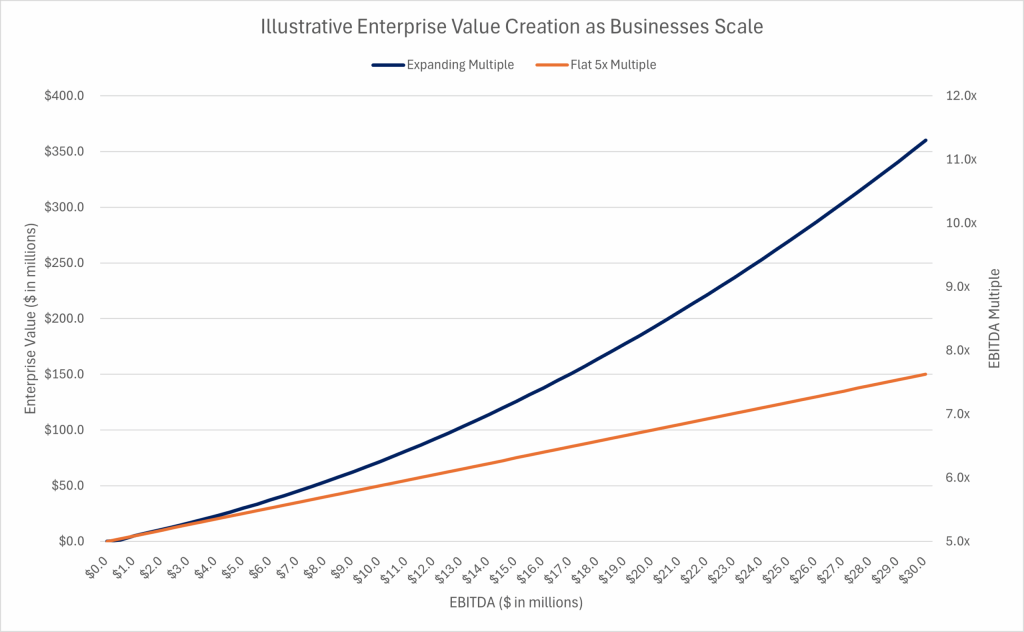
On this chart, we can see EBITDA plotted along the x-axis, the valuation multiple on the right y-axis (rising from 5x for smaller businesses to 12x for larger ones), and the resulting enterprise value on the y-axis on the left.
What stands out immediately is that the enterprise value line isn’t straight – it curves upward. This visualization demonstrates how wealth creation accelerates as your business scales.
For example (and not tying exactly to the chart above which is illustrative in nature):
- At $1M EBITDA with a 5x multiple: $5M enterprise value
- At $3M EBITDA with a 7x multiple: $21M enterprise value (value grew 4.2x while EBITDA only grew 3.0x)
- At $10M EBITDA with a 10x multiple: $100M enterprise value (value grew 20x while EBITDA grew 10x)
- At $25M EBITDA with a 12x multiple: $300M enterprise value (value grew 60x while EBITDA grew 25x)
Practical Example: The Compounding Growth Effect
Let’s examine a concrete example of how this non-linear growth effects business value and personal wealth:
Scenario A: Linear Growth Assumption
- Year 1: $2M EBITDA × 6x multiple = $12M value
- Year 5: $5M EBITDA × 6x multiple = $30M value
- Value increase: $18M (2.5x growth)
Scenario B: Non-Linear Growth Reality
- Year 1: $2M EBITDA × 6x multiple = $12M value
- Year 5: $5M EBITDA × 9x multiple = $45M value
- Value increase: $33M (3.8x growth)
The difference between these scenarios is $15 million in additional enterprise value – despite identical EBITDA performance. This gap represents the additional value created from multiple expansion that is important to take into account in growth and exit planning.
While we’ll explore the specific factors that drive multiple expansion in greater detail in a future article, it’s important to understand that businesses command higher multiples as they scale due to reduced risk profiles, expanded buyer universes, and enhanced strategic optionality.
The Operating Leverage Effect: How EBITDA Growth Accelerates
There’s another crucial dynamic at play that makes business value creation even more non-linear: operating leverage. This concept explains why EBITDA often grows faster than revenue (measured in growth percentage) as a business scales, creating an additional acceleration effect on top of multiple expansion.
Operating leverage occurs because many business costs are fixed or semi-fixed, meaning they don’t increase proportionally with revenue growth. Consider these examples:
Fixed Cost Structure Benefits
- Executive Team: A $5M revenue business and a $15M revenue business often share similar executive structures. You don’t need two CEOs, two CFOs, or two heads of operations to triple your revenue. This executive-level cost spreading creates immediate margin expansion.
- Infrastructure Investments: Core systems, software licenses, and operational infrastructure often have significant capacity built in. A $100,000 ERP system can typically support 2-3x the revenue before requiring major upgrades.
- Administrative Functions: HR, accounting, legal, and other administrative functions scale much more efficiently than revenue. One staff accountant might handle $2M in revenue; that same person can often manage $6M+ with minimal additional support.
Real-World Operating Leverage Example
Let’s examine how operating leverage works in practice:
Year 1 Baseline:
- Revenue: $5M
- Variable Costs (60% of revenue): $3M
- Fixed Costs (salaries, rent, systems): $1.5M
- EBITDA: $500K (10% margin)
Year 3 After Growth:
- Revenue: $10M (100% increase)
- Variable Costs (60% of revenue): $6M
- Fixed Costs (minimal increase): $1.7M (only 13% increase)
- EBITDA: $2.3M (23% margin)
The Results:
- Revenue doubled (2.0x increase)
- EBITDA increased by 4.6x ($500K to $2.3M)
- EBITDA margin expanded from 10% to 23%
This dramatic EBITDA acceleration happens because the $5M in additional revenue required only $3M in additional variable costs and $200K in additional fixed costs.
Being Deliberate with Operating Leverage
Operating leverage is a powerful wealth creation tool, but it’s important to approach it strategically. While it accelerates EBITDA growth during revenue expansion, it can equally amplify losses during revenue contraction.
The Double-Edged Nature of Operating Leverage
Consider our earlier example in reverse: If that business with $10M revenue and $2.3M EBITDA suddenly lost half its revenue due to market conditions:
- Revenue drops to $5M (50% decline)
- Variable costs drop to $3M (tracking with revenue)
- Fixed costs remain at $1.7M (can’t easily reduce executive team, systems, rent)
- EBITDA falls to $300K (87% decline)
This dramatic sensitivity works both ways – the same fixed cost structure that creates outsized gains during growth creates outsized pain during contraction.
Strategic Approaches to Operating Leverage:
- Invest in Scalable Systems Thoughtfully: Build infrastructure that can handle 2-3x your current volume, but look to find ways components can be scaled back if needed. For example, with technology spend, consider cloud-based solutions over fixed infrastructure where possible.
- Balance Fixed and Variable Costs: While some fixed costs drive efficiency, maintaining flexibility is crucial. Consider structuring roles with variable compensation components or using contractors for non-core or specialized business functions.
- Time Your Fixed Cost Investments: Add major fixed costs (senior hires, facility expansions) when you have strong confidence in future revenue growth. Avoid big fixed cost additions during uncertain market conditions.
- Build Operating Leverage Gradually: Rather than making dramatic infrastructure investments all at once, build capacity incrementally as demand proves sustainable.
- Plan for Different Scenarios: Maybe most importantly, model how your cost structure performs under various revenue scenarios. Understanding your breakeven point and cash flow sensitivity helps inform strategic decisions.
When leaning into operating leverage makes sense:
- Your market has strong, predictable growth trends
- You have diversified revenue sources reducing risk of major client losses
- Your cash position can weather potential downturns
- You’re in a market-leading position with sustainable competitive advantages
When to be more conservative:
- Your industry faces significant disruption or uncertainty
- You have high customer concentration risk
- Market conditions are volatile or declining
- Your business model is still evolving or unproven at scale
The key is being intentional about your operating leverage rather than accidentally creating it. The businesses that benefit most from operating leverage are those that deliberately build it during periods of strength and maintain enough flexibility to adapt when conditions change.
Strategic Implications for Business Owners
The Compounding Effect
When you combine multiple expansion with operating leverage, the wealth creation impact becomes exceptional:
Scenario: Operating Leverage + Multiple Expansion
- Year 1: $500K EBITDA × 5x multiple = $2.5M enterprise value
- Year 3: $2.3M EBITDA × 7x multiple = $16.1M enterprise value
- Total value increase: 6.4x (from just doubling revenue)
Compare this to a linear assumption where EBITDA simply doubled with revenue:
- Year 3: $1M EBITDA × 5x multiple = $5M enterprise value
- Linear value increase: 2.0x
The difference between understanding and ignoring these dynamics is over $11M in enterprise value in this example.
Practical Strategies for Non-Linear Growth
This non-linear growth dynamic creates several important strategic opportunities for business owners:
1. Focus Relentlessly on EBITDA Maximization
Rather than trying to hit specific valuation multiples (which are largely market-driven and outside your control), concentrate on what you can control: growing and optimizing EBITDA while building a world-class business. The multiple will follow based on the strength of your business fundamentals.
- Prioritize initiatives with the highest EBITDA impact
- Measure every major decision against its long-term effect on value
- Remember that EBITDA growth has compound effects on business value
2. Stage-Appropriate Value Driver Focus
Different growth stages require different strategic emphases:
- Early Stage ($1-3M EBITDA): Establish profitability, build repeatable processes, develop initial management team. At this stage, you’re focused on building scale to achieve “escape velocity” where you can get away from the gravitational pull of day-to-day operations.
- Growth Stage ($3-10M EBITDA): Scale systems, diversify customer base, build complete management team that can operate without you
- Scale Stage ($10M+ EBITDA): Focus on strategic positioning, market leadership, and preparing for institutional buyers
3. Strategic Growth vs. Profitability Decisions
Understanding non-linear value creation changes how you think about growth investments:
- Sometimes accepting temporarily lower margins to fuel faster growth makes strategic sense (within reason of course)
- The multiple expansion effect can partially offset short-term margin compression (though if it goes too far and you end up with a structurally lower margin business that cannot increase margin over time, it can also negatively impact multiple)
- Evaluate growth opportunities based on their impact on long-term enterprise value, not just immediate profitability
4. Build Optionality Into Your Operating Structure
Given the power of operating leverage, structure your business to capture upside while managing downside risk:
- Invest in scalable systems that can handle 2-3x current volume
- Balance fixed and variable costs to maintain flexibility
- Time major fixed cost investments to periods of revenue certainty
- Model different scenarios to understand your business’s sensitivity to revenue changes
5. Consider the Total Value Equation
When making major business decisions, evaluate them through the lens of total enterprise value impact:
- How will this decision effect EBITDA growth?
- How might it influence the business’s risk profile and attractiveness to buyers?
- What is the combined effect on both earnings growth and potential multiple expansion?
If you’re looking for more information on how to understand or think through these moving pieces, we’d be happy to engage in a conversation. Feel free to reach out directly or click here to take our COMPASS Score as a first step: https://panoramiccp.com/compass-score/
Panoramic Capital Partners (“Panoramic”) is a registered investment advisor.
The information provided is for educational, informational, and illustrative purposes only and does not constitute investment advice and it should not be relied on as such. It should not be considered a solicitation to buy or an offer to sell a security. It does not take into account any investor’s particular investment objectives, strategies, tax status or investment horizon. Panoramic Capital Partners and its advisors do not provide legal, accounting, or tax advice. You should consult your attorney or tax advisor.
The views expressed in this commentary are subject to change based on market and other conditions. This article may contain certain statements that may be deemed forward looking statements. Please note that any such statements are not guarantees of any future performance and actual results or developments may differ materially from those projected. Any projections, market outlooks, or estimates are based upon certain assumptions and should not be construed as indicative of actual events that will occur.
The above targets are estimates based on certain assumptions and analysis made by the advisor. There is no guarantee that the estimates will be achieved.
All information has been obtained from sources believed to be reliable, but its accuracy is not guaranteed. There is no representation or warranty as to the current accuracy, reliability, or completeness of, nor liability for, decisions based on such information and it should not be relied on as such.
Advisory services are only offered to clients or prospective clients where Panoramic and its representatives are properly licensed or exempt from licensure.