
We’ve been sitting with a question that plagues many of the entrepreneurs we work with: How did something that started with such clarity and purpose start to burn me out?
You know the story. Maybe it’s your story. You started with fire in your belly, a mission to change something in the world, a product that had to exist, or maybe just a point to prove. Fast forward a few years, and you’re drowning in meetings you shouldn’t be in, making decisions you hired someone else to make, and chasing your next big customer deal wondering if it finally fill that void where your original spark used to live.
Let us share what we’ve learned about finding your way back – not through another productivity system or management framework, but through understanding and defining your NorthStar.
What You’ll Discover:
- Why becoming a successful entrepreneurs often leads to moments of feeling burnt out and torn apart
- The three-legged stool framework for defining your true NorthStar
- Practical tools for using your NorthStar as a decision-making compass
- How to embrace the natural tension along the way rather than be torn apart by it
THE PROBLEM
Whether you know it or not, you already have a NorthStar (or at least you used to). It’s been there all along – it’s the reason you took the leap in the first place, the invisible force that gets you up every morning to keep building when logic says you should quit. Every entrepreneur we’ve ever met started with one, and, whether conscious or not, it’s what turned your idea into action.
But here’s where things get messy.
The entrepreneurial journey has a way of taking that purity of desire and turning it into something unrecognizable. Think about your early days. Remember that laser focus? That certainty about what mattered?
What starts as a mission to build a better mousetrap transforms into a complex organism: customers with endless needs, employees with their own dreams and dramas, supply chains that break at the worst moments, financial obligations that never sleep. Each of these things is good in isolation – necessary even. But collectively? They can become puppet strings, each one pulling you in a different direction until you don’t know which way is up.
The simplicity of early focus – “I’m going to build the best X the world has ever seen” – fades into an endless struggle of choice. What do I work on next? How do I prioritize when everything seems urgent? The plate will never be empty, so what do I do to keep moving forward without falling apart?
Do this long enough, and what feels like “management” or “leadership” turns into a daily rhythm that slowly unravels you. Said another way – it disintegrates you. You’re no longer a whole person moving toward a clear destination; you’re fragments of attention scattered across a hundred different priorities.
The Fire Blanket Risk
So what’s really at risk here? It’s the snuffing out of that original fire. The work of management becomes a fire blanket to your soul, crushing your early focus and desires. And here’s where it gets really insidious: As your vitality withers, disintegration accelerates. You start chasing that lost energy in other places. What originally came from the joy of single-minded pursuit is now sought in that next trip, that next car, that next acquisition.
There’s nothing inherently wrong with any of these things. But it’s the proliferation of attention that weighs on us.
The Competency Trap
Your ability to extend your competency into new areas is exactly what allowed you to succeed in the early days. You could be the product developer AND the salesperson AND the finance team AND the HR manager. That flexibility, that willingness to wear every hat, is what got you here.
But the more you grow, the more you have to give things up. Others need to take your space, freeing you to focus back on your NorthStar. Your broad competency is required for a time, but eventually it becomes a weight vest that can hold you back from allowing your company to thrive without you as you seek to maintain control of what was. Beyond weighing you down personally, it massively constrains the value of your business.
Cutting to the chase: The power of the individual is what gets you started. But at some point, you must trade the power of the individual for the power of the team, and eventually for the power of the organization.
In today’s society, this might be the hardest part. We live in a world powered by personal brands, where the founder is the face of everything. And yet, for your company to scale and for you to not fall apart, you must elevate others.
Don’t misread this. This isn’t to say you disappear. It’s to say that for you to elevate and integrate, you must focus and release. Allow others to elevate. Empower them and move out of the way, releasing the need to be part of every decision, every meeting, every moment.
The Root of the Problem
So what’s really going on here? Two things:
First: You’re playing someone else’s game.
Society says build a unicorn. Your investors say grow at all costs. Your peers are posting their exits on LinkedIn. Your parents wanted you to be “successful,” which probably meant stable, prestigious, wealthy.
Alex Lieberman, co-founder of Morning Brew, has been remarkably candid about this. After losing his father in college, he had a realization that changed everything: he stopped caring about doing a job just for the sake of what other people expected. He was the first person in his family in three generations NOT to pursue a career on Wall Street – the expected path, the “successful” path.
He’s also talked openly about how much of his early motivation came from fear – fear of not being accepted, fear of not belonging, fear of not having enough money after his father’s passing left his family without a breadwinner. These were powerful motivators that helped him build a $75M+ media company.
But after the fear-motivated success was achieved, what came next? Per Alex, “When money is no longer really an object, how do you find the thing that acts as strong of a motivator as when that was the primary motivator?” He’s learning to shift from fear-based motivation to what he calls “growth-based motivation” – building because you want to, not because you’re trying to prove something to the haters or fill a void.
The question is: How much of your journey is driven by your own NorthStar, and how much is driven by someone else’s definition of where you should be headed?
Second: You give everything to be “successful” but ultimately get your priorities completely out of line.
Success in business while your marriage falls apart isn’t success. A $50M exit while you’ve missed every important moment of your kids’ childhood isn’t success. Financial wealth while you’re burned out, unhealthy, and disconnected from any sense of purpose isn’t success.
Success in one area while everything else falls apart isn’t success at all – it’s just optimization for the wrong metric.
How Your NorthStar Becomes the Solution
A NorthStar isn’t a magic bullet. But here’s what we know: If you don’t know where North is, you can’t drive toward it. And if you aren’t measuring your direction, you can’t stay on course.
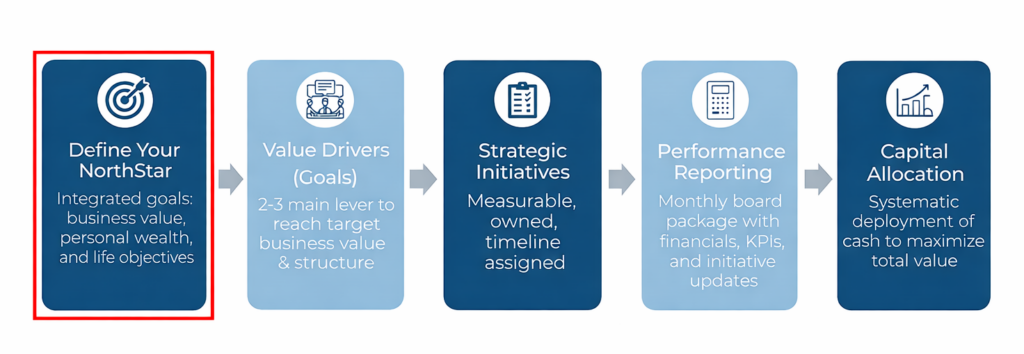
This is why the NorthStar is the starting point of our entire value creation system – it sets direction. Most importantly, it’s written by you, not for you. And secondly, it’s integrated, encompassing your business, your finances, and your personal life as one coherent whole.
THE FRAMEWORK
Take a second to pause and reflect on everything you’ve just read – most of it is about your business and your relationship to it because your business demands one thing. Growth. Scale. Reinvestment. Long hours. Full commitment. That writing was intentional – it shows how one dimensionally focused we get and how it’s so easy to become unbalanced.
So, the solution has to provide an equally strong counterbalance that represents the multi-dimensional reality of our lives.
Think of your NorthStar as a three-legged stool. Remove any leg, and the whole thing topples:
1. Your Business Vision
This is probably the easiest one for entrepreneurs to articulate. What impact do you want your business to have? What problem are you solving? What legacy are you building? Do you have a specific company value that you’re chasing? But here’s the key – this can’t be in isolation from the other two legs.
2. Your Personal Financial Goals
Not just “I want to be rich” but real clarity: What does financial success mean to you? What lifestyle do you want to support? What security do you need? What do you want to be able to do with your wealth? And crucially – what’s enough?
3. Your Life Priorities
Who do you want to be as a human in relation to your family, your friends, your community, and yourself? What relationships matter most? How do you want to spend your time? What experiences do you refuse to sacrifice? What does a life well-lived look like when you’re 80 looking back?
Your true NorthStar must integrate all three, acknowledging and working with the tensions rather than pretending they don’t exist.
THE PRACTICE
Compass, Not GPS
Here’s a critical distinction: A NorthStar isn’t perfection. It’s not a GPS system with turn-by-turn directions to success. Instead, think of it as a compass – something that helps you know which direction you’re trying to go, but leaves space to navigate.
The path to your NorthStar will zig-zag. You’ll sometimes feel like you’re going backwards. That’s not failure – that’s navigation in the real world. The key is that even when you’re tacking back and forth like a sailboat in the wind, you’re still making progress in the right general direction.
There’s one other nuance that we need to tease out here: Much like a mission statement for a company, your NorthStar is as much about saying what you WILL focus on as it is saying what you WON’T focus on (in other words, quickly discerning the difference between North and South).
Think of it as a filter – a device to sift out the urgent but irrelevant, the exciting but unaligned, the profitable but purposeless. Every opportunity, every crisis, every decision gets run through this filter: Does this move me toward or away from my NorthStar?
Practical Application
Say your NorthStar includes building a business that generates $10M in annual profit while working no more than 30 hours per week and never missing your kids’ important events. Now every decision gets filtered through that lens:
- That exciting new product line that would require 60-hour weeks for the next year? Doesn’t fit for you – can someone else on the team handle it?
- Hiring a CEO so you can step back into a chairman role? Aligns with the integrated goals, is now the right time?
- That acquisition opportunity which would double revenue but require relocating? Makes sense for the business but depends on your personal/family goals.
The NorthStar doesn’t make decisions for you, but it makes decision-making infinitely clearer.
The Compass Check
Just defining your NorthStar isn’t enough. You need regular compass checks. In our system, we build in monthly or quarterly reviews where we ask:
- Are my actions aligned with my stated NorthStar?
- Has my NorthStar evolved (and if so, do I need to consciously update it)?
- What’s pulling me off course, and how do I correct?
Remember: You don’t know if you’re staying pointed north unless you actually check your compass.
THE JOURNEY – Embracing the Tension
This seeking of cohesion between who you are, what you’re building, and how you’re living – it’s a lifelong struggle. But, it’s not about avoiding the struggle or controlling it. It’s about engaging the tension with joy.
We need to name one specific tension. You didn’t chase your business solely because of some spreadsheet projection of how successful you could be. Fundamentally, you built because of an inherent desire to create. Sure, you knew it could work out financially, but it didn’t start with ROI calculations and performance metrics.
So, we must live in the tension that success will breed the need for performance metrics and building a system to stay on track. The business will demand its spreadsheets, KPIs, and quarterly initiatives.
But we cannot – must not – lose that inbred desire to build for the sheer sake of building something we believe in, whether or not it produces immediate returns.
This is what has made companies like Amazon so remarkable – the willingness to fail in service of the building, to pursue the Kindle Fire or the Fire Phone not because they were guaranteed wins but because they were worth trying. AND this desire to build is the source of initial energy that must be continually maintained and re-discovered to allow for sustainability along the entrepreneurial journey.
So where does this leave us? With an invitation – not to perfection, but to integration. Not to have it all figured out, but to be consciously engaged in the ongoing process of figuring out.
The business owners who thrive long-term aren’t the ones who avoid tension or achieve perfect balance. They’re the ones who know their NorthStar and use it to progress through the tension rather than be torn apart by it.
Your Next Step
If you’ve read this far, something resonated. Maybe you’re feeling that disintegration I described. Maybe you’re wondering where your original fire went. Maybe you’re successful by every external measure but empty by your own.
It’s time to define your NorthStar – not just for your business, but for your integrated life. Not what someone else says it should be, but what you know it needs to be.
This is why it’s the starting point of our entire NorthStar Value Creation system. Because without direction, all the strategy and tactics in the world won’t get you where you want to go. Or worse – they’ll get you efficiently to somewhere you never wanted to be.
Your NorthStar is waiting to be articulated. The only question is: Are you ready to be honest about what it really is?
Panoramic Capital Partners (“Panoramic”) is a registered investment advisor.
The information provided is for educational, informational, and illustrative purposes only and does not constitute investment advice and it should not be relied on as such. It should not be considered a solicitation to buy or an offer to sell a security. It does not take into account any investor’s particular investment objectives, strategies, tax status or investment horizon. Panoramic Capital Partners and its advisors do not provide legal, accounting, or tax advice. You should consult your attorney or tax advisor.
The views expressed in this commentary are subject to change based on market and other conditions. This article may contain certain statements that may be deemed forward looking statements. Please note that any such statements are not guarantees of any future performance and actual results or developments may differ materially from those projected. Any projections, market outlooks, or estimates are based upon certain assumptions and should not be construed as indicative of actual events that will occur.
The above targets are estimates based on certain assumptions and analysis made by the advisor. There is no guarantee that the estimates will be achieved.
All information has been obtained from sources believed to be reliable, but its accuracy is not guaranteed. There is no representation or warranty as to the current accuracy, reliability, or completeness of, nor liability for, decisions based on such information and it should not be relied on as such.
Advisory services are only offered to clients or prospective clients where Panoramic and its representatives are properly licensed or exempt from licensure.